 Cold nights
Guides
Language
EnglishCurrency
US dollar · $GetYourGuide shows prices in the currency you choose.
Guide · Best time
Sahara desert temperature range, month by month
The Sahara desert temperature range is wide: hot days and cold nights in the same 24 hours. Here are the real figures for the road to Merzouga, month by month, and what they mean for your trip.
Check availabilityfrom $137 · free cancellation
Editorial team, marrakech-to-merzouga.comUpdated October 24, 20266 min read16 sources
Quick answer
- 01Day and night
- Across the Sahara, about 20 °C by day and 5 °C at night in December to February.1
- 02Summer
- About 40 °C by day and 25 °C at night in June to August.1
- 03Hottest month
- July at Errachidia: average high 39.5 °C.2
- 04Coldest nights
- January at Errachidia: average low 2 °C.2
- 05Mildest
- April and October, with highs of 26.1 and 26.8 °C.2
Why the desert is hot by day and cold by night
Britannica describes the northern Sahara as having a dry subtropical climate with unusually large yearly and daily temperature ranges, cold to cool winters and hot summers.3 On average across the desert, days and nights run about 20 °C and 5 °C from December to February, and about 40 °C and 25 °C from June to August.1
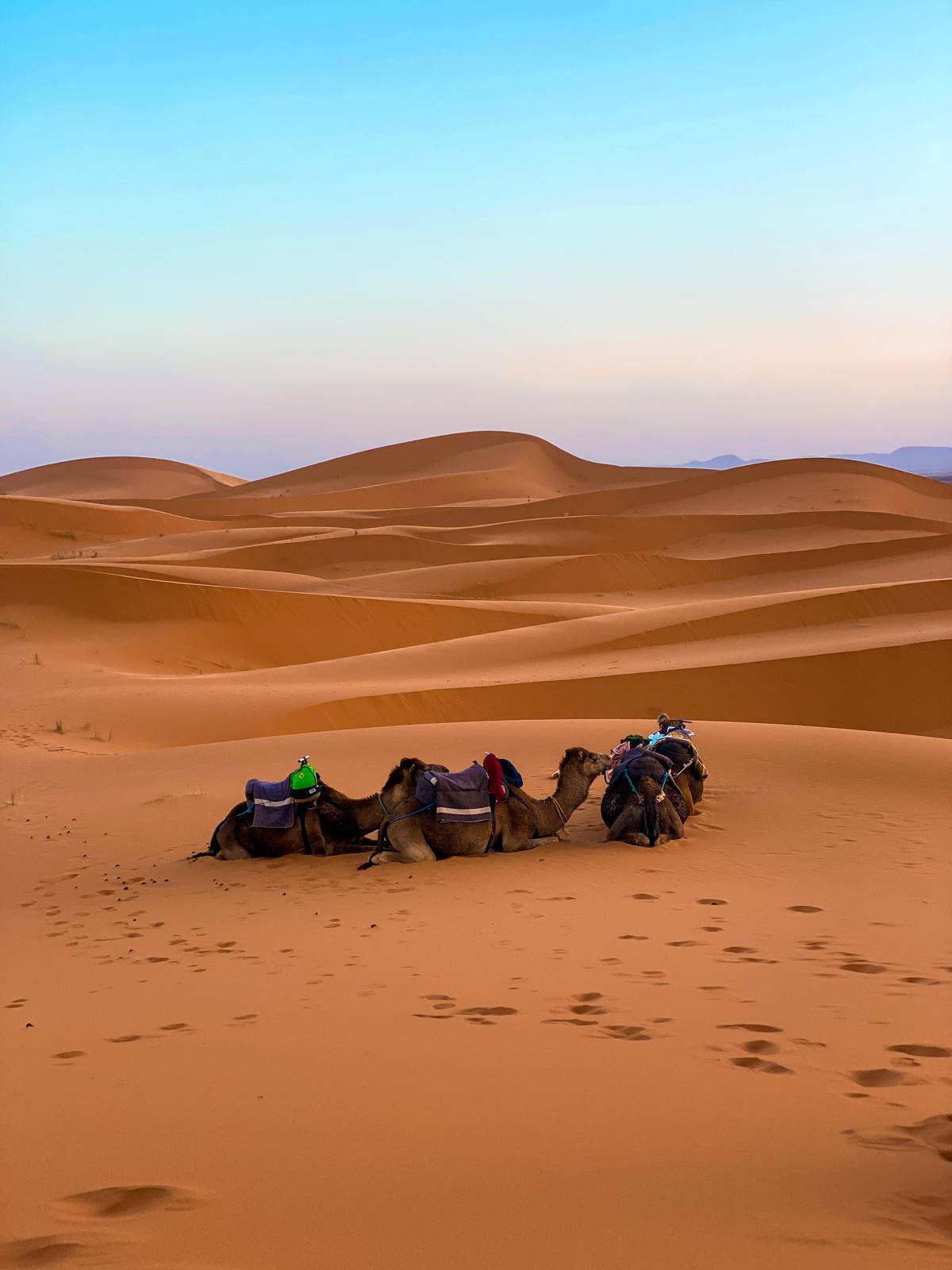
In practice, a day of shorts and sunscreen can end in a night of jackets and blankets. On the tour this site recommends, the operator puts its November to February desert nights at 0 °C to 5 °C. The contrast is greatest in the clear, dry months, and it is easy to forget if you pack only for the daytime heat they expect from the word desert.
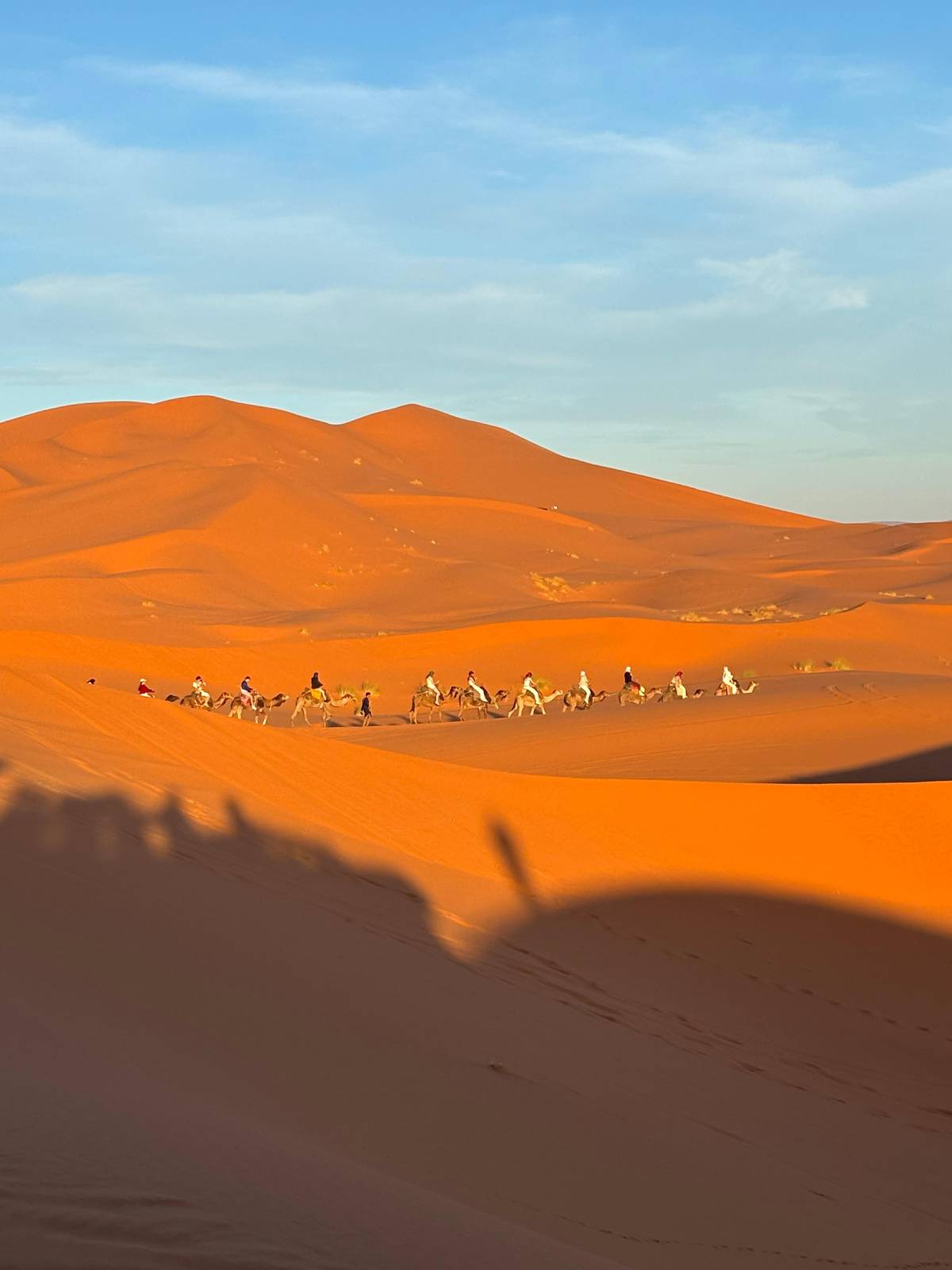
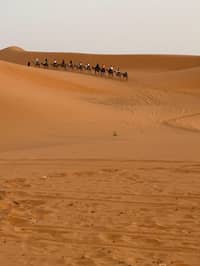
That range shapes the rhythm of a desert tour. The long drive happens in the vehicle through the warm middle of the day, and the time on the sand is pushed to the edges: the camel ride out at sunset and the ride back at sunrise, as the tour we recommend lists them. Whatever the month, plan for two climates in one day, the afternoon in the dunes and the night in the camp.
The desert year
What each season brings
-
Dec to Feb
Cold nights
Days around 20 °C, nights around 5 °C across the Sahara.1
-
Spring
Dusty winds
Hot dusty southerly winds are most common in spring.4
-
Late spring, summer
Chergui
A hot dusty wind from the Sahara can cross the mountains.5
-
Jun to Aug
Peak heat
Days around 40 °C, nights around 25 °C across the Sahara.1
-
August
Storm peak
A second maximum of thunderstorms comes in August.6
-
Sep to Oct
Wettest months
Errachidia's rain peaks in October.2
Where these figures come from
There is no long-term weather station in the dunes of Erg Chebbi. The nearest station with published World Meteorological Organization normals is Errachidia, 103 km north of Merzouga and 1,037 m above sea level, whose 1991 to 2020 normals are published by the World Meteorological Organization.7 The month-by-month figures on this page come from that station.
Errachidia lies higher than the dunes and in the Ziz valley; treat its figures as a close guide rather than an exact reading of the camp. The daylight hours in the table are our own calculation for Merzouga's latitude, not a station figure. Use them as a guide to the season and its swings between day and night, not as a forecast for the camp on the evening you arrive.
For the start and end of the trip, the same normals exist for Marrakech and Ouarzazate. Marrakech averages 19.1 °C by day in January and 37.7 °C in July; Ouarzazate, on the Saharan side of the High Atlas, 17.3 °C and 38.8 °C.89 The mountains between them are colder still.
Month by month
Hours without sun and rainy days near Merzouga
Hours without sunDays with precipitationSeason
Climate table
Temperatures, rain and day length by month
| Month | Daylight (h) | Darkness (h) | High / low | Wet days | In the dunes |
|---|---|---|---|---|---|
| Jan | 10.3 | 13.7 | 16 / 2 °C | 1 | Cold nights |
| Feb | 11.1 | 12.9 | 18 / 5 °C | 2 | Cold nights |
| Mar | 11.9 | 12.1 | 22 / 9 °C | 2 | Mild days |
| Apr | 12.9 | 11.1 | 26 / 13 °C | 1 | Warm days |
| May | 13.7 | 10.3 | 30 / 17 °C | 2 | Hot days |
| Jun | 14.2 | 9.8 | 35 / 22 °C | 1 | Very hot |
| Jul | 14 | 10 | 40 / 26 °C | 1 | Very hot |
| Aug | 13.3 | 10.7 | 38 / 25 °C | 2 | Very hot |
| Sep | 12.4 | 11.6 | 33 / 20 °C | 3 | Hot days |
| Oct | 11.5 | 12.5 | 27 / 14 °C | 3 | Warm days |
| Nov | 10.6 | 13.4 | 21 / 8 °C | 2 | Cold nights |
| Dec | 10.1 | 13.9 | 17 / 4 °C | 2 | Cold nights |
Errachidia station, 1991 to 2020: World Meteorological Organization averages of the daily high, the daily low and the number of rainy days reaching a millimetre. Mid-month day length is our own figure for the latitude of Merzouga.2 Season according to Encyclopaedia Britannica.1
Decision helper
Which month suits you?
Start from what matters most to you
April or October
Highs of 26.1 and 26.8 °C at Errachidia.2
Book a heated tent
Standard tents have no heating from November to February on our pick.
Go, but plan for heat
July averages a high of 39.5 °C at Errachidia.2
June
About 14.2 hours of daylight at mid-month, by our calculation.2
Late spring and summer
From April to August, Errachidia gets 3 to 9 mm a month.2
Daily temperature swings are considerable during both the winter and summer months across the desert, ranging on average from about 68 °F (20 °C) and 41 °F (5 °C) between December and February and from 104 °F (40 °C) and 77 °F (25 °C) between June and August.
Winter: December to February
Winter days are bright and mild. At Errachidia the average high is 16.7 °C in December, 15.9 °C in January and 18.2 °C in February.2 In the sun on a dune that feels pleasant, and the light is clear for photographs.
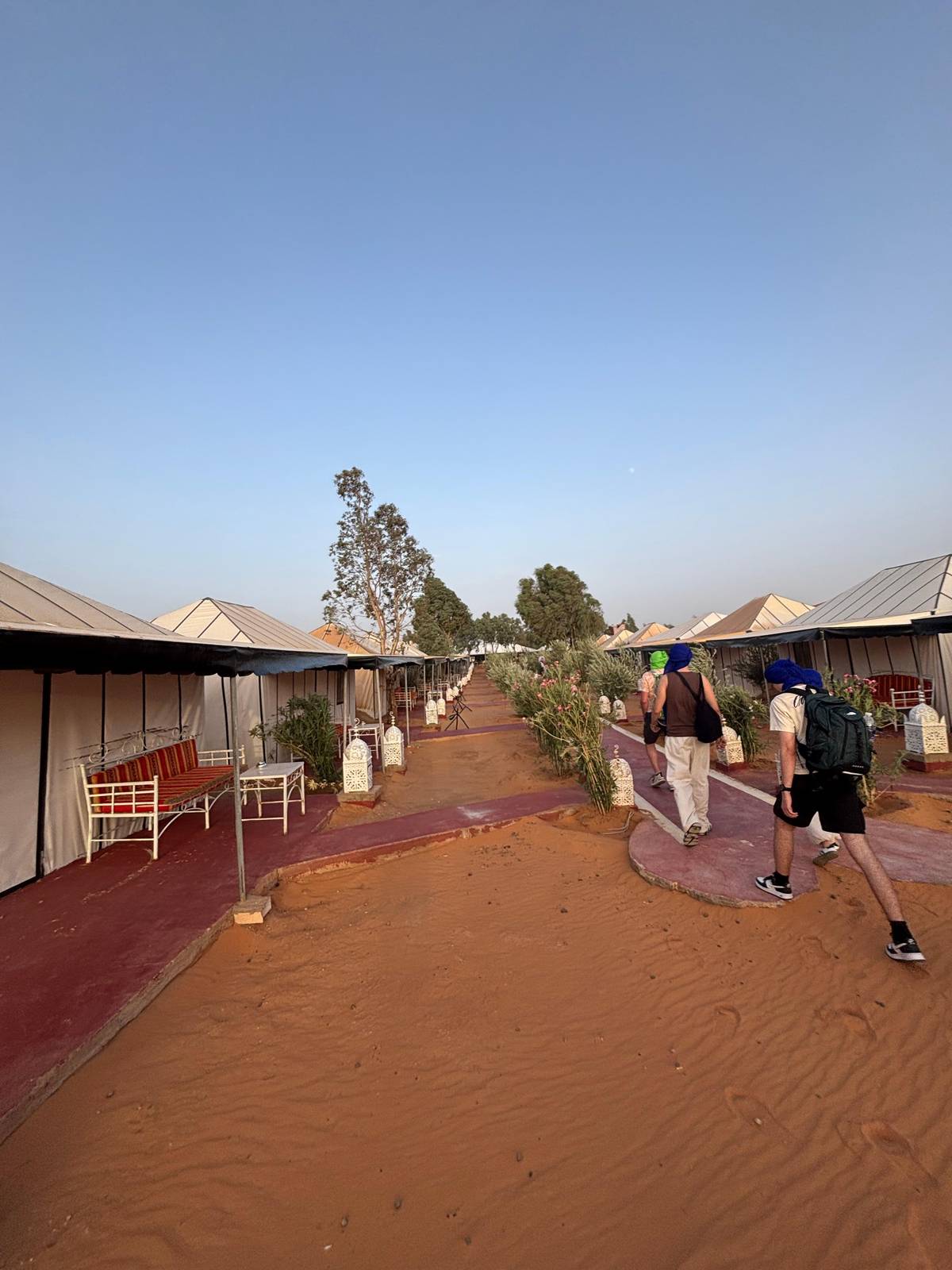
Nights are the challenge. Average lows are 3.5 °C in December, 2 °C in January and 4.6 °C in February at the station.2 On our recommended tour, standard tents have warm blankets but no heating from November to February, while luxury tents are heated.
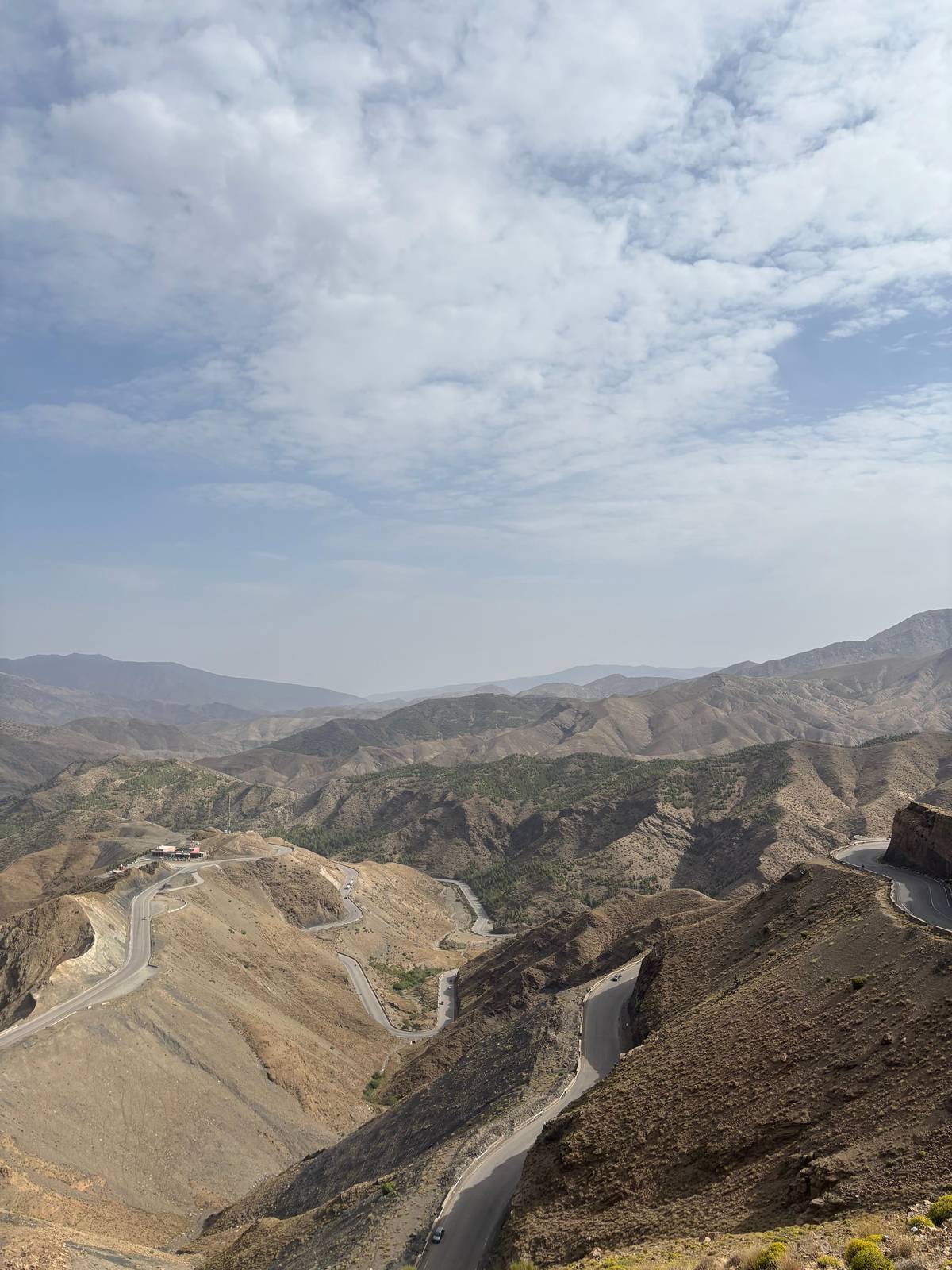
Snow falls occasionally over the northern plateaus of the Sahara, and the High Atlas passes on the way can be cold.10 If you travel in winter, book a heated tent if you can, pack a hat, gloves and a down or fleece jacket, and sleep in layers. Keep that warm layer in your small backpack, not in the suitcase that stays in the vehicle, and dress for the sunrise ride the night before.
Checklist
Packing for the temperature range
01
Every month
- Sun hat, sunglasses and sunscreen
- A warm layer for the night and sunrise
- A refillable water bottle
02
By season
- Winter: down or fleece jacket, hat and gloves
- Summer: loose long sleeves and a scarf
- Spring: a scarf against dust
Video
Overnight in the Sahara desert: it was freezing
The video starts loading once you tap play.
Spring and autumn: the comfortable months
March, April, October and November sit between the extremes. Average highs at Errachidia are 22.1 °C in March, 26.1 °C in April, 26.8 °C in October and 20.6 °C in November.2 Nights fall to between 7.7 °C and 14.2 °C on average in those months.2
If you are looking for the best month for a Sahara tour, these are the strongest candidates: warm enough to enjoy the dunes at sunset, cool enough to sleep well in a standard tent with a jacket for the sunrise ride. Day length is comfortable too, from about 10.6 hours in November to 12.9 hours in April by our calculation.2
Spring has one catch. Hot southerly winds that often carry dust are a feature of the northern Sahara and are especially common in spring.4 A scarf for your face and sunglasses for your eyes make a sandy afternoon much easier. October is also the month with the most rain at Errachidia, though that still means only a few wet days.2
Summer: June to August
Summer is hot. Errachidia averages daily highs of 35.4 °C in June, 39.5 °C in July and 38.2 °C in August, and nights stay warm, around 22 °C to 25.8 °C.2 In late spring or summer the chergui, a hot dusty wind from the Sahara, can sweep over the mountains into the lowlands.5
The tours still run, and the sunset and sunrise rides happen in the coolest parts of the day. One overnight trek from Merzouga moves its departure later in summer, to 18:00 instead of 16:00. The midday hours are for the shade of the vehicle, the hotel or the camp. At night the reverse is true: the camp is mild enough to sit outside under the stars for a long time.
If summer is your only time, drink more than you think you need, cover your head and shoulders, and ask whether your camp option includes air conditioning. One one-way tour lists deluxe tents with air conditioning or heating.
Rain and storms
It rarely rains. Errachidia gets 133.0 mm of precipitation in a normal year, on about 21.3 days with 1 mm or more.711 The wettest months are October, with 21 mm, and September, with 18 mm.2
When it does rain, it can come hard. Across the northern Sahara as a whole, most precipitation falls from December through March, with a second maximum of thunderstorms in August, and such storms can cause flash floods in places where no rain fell.612 At Errachidia itself, September and October are wetter than any winter month.7 In the gorges on the way, follow your driver-guide's advice if water is running.
Marrakech, at the start of the trip, is wetter than the desert, with 221.0 mm in a normal year.13 Pack a light rain jacket for the city in winter even if you will not need it in the dunes. In the desert itself, a light shell against wind and sand is the only weather gear the dry months call for.
Is the Sahara the hottest desert?
Britannica calls the Sahara the largest hot desert in the world, covering some 8.6 million square km.1415 Size and heat are not the same thing, and Britannica's figures for the whole desert are averages over a huge area. What matters on a tour is the climate of the small corner of it you visit, at the time of year you go.
In the southern Sahara, Britannica notes that late spring and early summer are hot, and that high temperatures of 50 °C are not unusual there.16 The Moroccan Sahara around Merzouga lies in the north of the desert, where the climate is dry subtropical with cold to cool winters.3
For your trip the practical figures are the ones from Errachidia: a July average high of 39.5 °C and a January average low of 2 °C.2 Plan for both ends of that range, and you can enjoy the desert in any month. A sunset ride in a light shirt and a sunrise ride in a fleece is the normal pattern in the cooler half of the year.
Your desert trip
Three days, one night in the dunes.
Pick a date, get collected at your riad, and cancel free up to 24 hours before.


You ask,we answer.
Is the Sahara desert the hottest desert in the world?
It is the largest hot desert. Britannica calls it the largest hot desert in the world, covering some 8.6 million square km.1415
How cold does the Sahara get at night in winter?
Around 0 to 5 °C in the camps. Our recommended tour gives 0 °C to 5 °C for nights from November to February.
What is the hottest month near Merzouga?
July. Errachidia, the nearest station, averages a daily high of 39.5 °C in July.2
When is the best time for a desert tour?
Spring and autumn. April and October average highs of 26.1 and 26.8 °C at Errachidia, with mild nights.2
Does it rain in the Moroccan Sahara?
Very little. Errachidia averages 133.0 mm a year; October and September are the wettest months.7
Does it ever snow in the Sahara?
Occasionally, in the north. Britannica notes that snow falls occasionally over the northern plateaus of the Sahara.10
How long are the days in winter?
About 10 hours of daylight. At Merzouga's latitude the sun is up about 10.1 hours in mid-December, by our calculation.2
Sources
What this text is based on
- 1Encyclopaedia BritannicaSahara: Climate↩
- 2World Meteorological OrganizationWMO Climate Normals, Station Errachidia (WMO 60210), 1991 to 2020↩
- 3Encyclopaedia BritannicaSahara: Climate↩
- 4Encyclopaedia BritannicaSahara: Climate↩
- 5Encyclopaedia BritannicaMorocco: Climate↩
- 6Encyclopaedia BritannicaSahara: Climate↩
- 7World Meteorological Organization (Climate Normals 1991-2020, archived by the US National Centers for Environmental Information)Single station data sheet: ERRACHIDIA, WMO 60210↩
- 8World Meteorological Organization (Climate Normals 1991-2020, archived by the US National Centers for Environmental Information)Single station data sheet: MARRAKECH, WMO 60230↩
- 9World Meteorological Organization (Climate Normals 1991-2020, archived by the US National Centers for Environmental Information)Single station data sheet: OUARZAZATE, WMO 60265↩
- 10Encyclopaedia BritannicaSahara: Climate↩
- 11World Meteorological Organization (Climate Normals 1991-2020, archived by the US National Centers for Environmental Information)Single station data sheet: ERRACHIDIA, WMO 60210↩
- 12Encyclopaedia BritannicaSahara: Climate↩
- 13World Meteorological Organization (Climate Normals 1991-2020, archived by the US National Centers for Environmental Information)Single station data sheet: MARRAKECH, WMO 60230↩
- 14Encyclopaedia BritannicaSahara↩
- 15Encyclopaedia BritannicaSahara↩
- 16Encyclopaedia BritannicaSahara: Climate↩